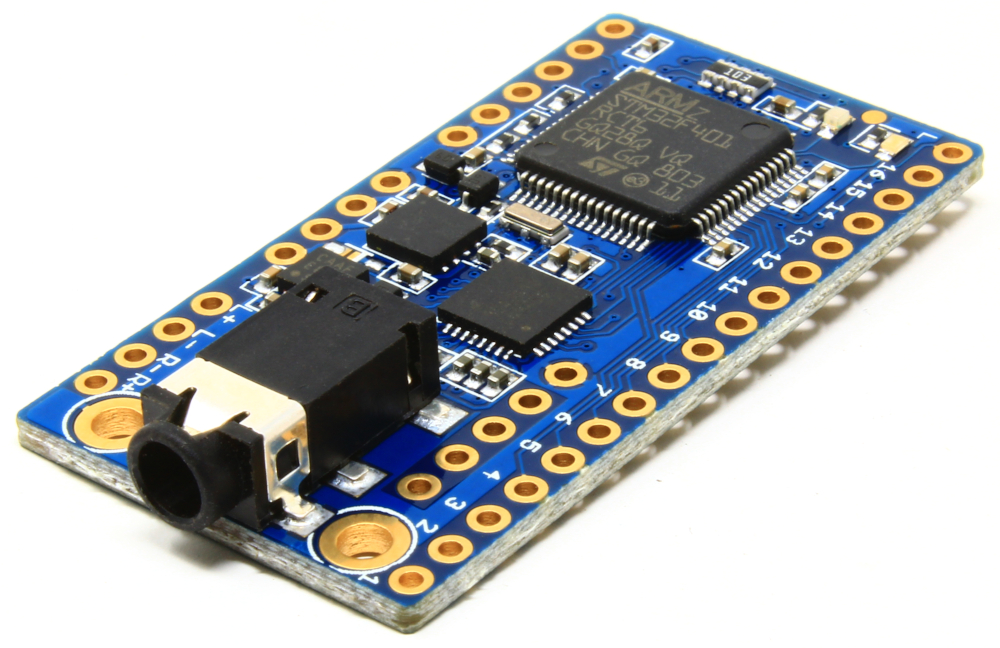
This is a library for interfacing your Arduino with a WaveTooEasy board using serial communication.
Download the zip file from this page (green button at upper-right corner) and copy it into your libraries folder, or click on the Sketch menu in the Arduino IDE, then Include Library and Add .ZIP Library. Select the ZIP file you have downloaded.
Refer to the WaveTooEasy manual for instructions on how to connect the WaveTooEasy to an Arduino using the Serial port.
- WaveTooEasy product page
- WaveTooEasy manual
- WaveTooEasy - Library for Arduino
- WaveTooEasy - Generic C library
-
Add the
WaveTooEasy.hfile to you sketch, like this:#include <WaveTooEasy.h>
-
Instantiate an Artekit_WaveTooEasy class. Optionally you can specify the Serial port you want to use, for example
Serial,Serial2, etc., and the baudrate if different from 115200 (the default baudrate).Artekit_WaveTooEasy WaveTooEasy();Example specifying Serial object and baudrate:
Artekit_WaveTooEasy WaveTooEasy(Serial1, 57600);
-
In your
setup()function, callbegin().void setup() { // Initialization WaveTooEasy.begin(); }
-
After calling
begin(), you can use any of the WaveTooEasy functions to play audio:void setup() { // Initialization WaveTooEasy.begin(); // Play a WAV file on channel 5 WaveTooEasy.playFile("my_audio_file.wav", 5, PLAY_MODE_NORMAL); } void loop() { // Play beep on channel 2 every second WaveTooEasy.playFile("beep.wav", 2, PLAY_MODE_NORMAL); delay(1000); }
Use this function to poll for a connected WaveTooEasy board. Useful to check if the communication is working as it should.
Asks for the WaveTooEasy software version.
major, minor and fix are three pointers to numbers representing the WaveToEasy version in Semantic Versioning 2.0.0 format.
uint8_t major, minor, fix;

WaveTooEasy.getVersion(&major, &minor, &fix);Plays a file on a give channel.
file is a null-terminated string containing the full path of the file to play.
channel is the channel number (from 1 to 10).
mode can be PLAY_MODE_NORMAL for normal playback or PLAY_MODE_LOOP for looped playback.
// Play beep.wav on channel 2
WaveTooEasy.playFile("beep.wav", 2, PLAY_MODE_NORMAL);Plays the file that corresponds to a given channel. This channel<->file mapping is configured in the configuration file. Refer to [WaveTooEasy documentation] to learn how to map a file to a channel. In case there is no file mapped to a channel, WaveTooEasy will try to play the [channel].wav file, where channel is the number you provide to this function.
channel is the channel number (from 1 to 10).
mode can be PLAY_MODE_NORMAL for normal playback or PLAY_MODE_LOOP for looped playback.
// Play whatever file is mapped to channel 1
WaveTooEasy.playChannel(1, PLAY_MODE_NORMAL);Stops the playback on a given chanel.
channel is the channel number (from 1 to 10).
// Stop playback on channel 1
WaveTooEasy.stopChannel(1);Stops the playback on all the channels.
WaveTooEasy.stopAll();Pauses the playback on a given channel.
channel is the channel number (from 1 to 10).
// Play beep.wav on channel 2
WaveTooEasy.playFile("beep.wav", 2, PLAY_MODE_NORMAL);

// Wait one second
delay(1000);

// Pause playback of channel 2
WaveTooEasy.pauseChannel(2);Pauses the playback on all the channels.
// Play beep.wav on channel 2
WaveTooEasy.playFile("beep.wav", 2, PLAY_MODE_NORMAL);

// Play music.wav on channel 3
WaveTooEasy.playFile("music.wav", 3, PLAY_MODE_LOOP);

// Wait one second
delay(1000);

// Pause all
WaveTooEasy.pauseAll();Resumes a paused channel.
channel is the channel number (from 1 to 10).
// Play beep.wav on channel 2
WaveTooEasy.playFile("beep.wav", 2, PLAY_MODE_NORMAL);

// Wait one second
delay(1000);

// Pause playback of channel 2
WaveTooEasy.pauseChannel(2);

// Wait one second
delay(1000);

// Resume playback on channel 2
WaveTooEasy.resumeChannel(2);Resumes all the channels that were put in pause with the pauseChannel() or the pauseAll() functions.
// Play beep.wav on channel 2
WaveTooEasy.playFile("beep.wav", 2, PLAY_MODE_NORMAL);

// Play music.wav on channel 3
WaveTooEasy.playFile("music.wav", 3, PLAY_MODE_LOOP);

// Wait one second
delay(1000);

// Pause all
WaveTooEasy.pauseAll();

// Wait one second
delay(1000);

// Resume all
WaveTooEasy.resumeAll();Retrieve the status code for all the channels.
channels is a pointer to an struct of type WTE_CHANNELS_STATUS, defined in the following way:
typedef struct wteChannelsStatus
{
	uint8_t channel1;
	uint8_t channel2;
	uint8_t channel3;
	uint8_t channel4;
	uint8_t channel5;
	uint8_t channel6;
	uint8_t channel7;
	uint8_t channel8;
	uint8_t channel9;
	uint8_t channel10;
} WTE_CHANNELS_STATUS;WTE_CHANNELS_STATUS status;
// Retrieve the status code for all the channels
WaveTooEasy.getAllChannelsStatus(&status);
// Check if channel 5 AND 6 are playing a file, otherwise make
// them play their corresponding WAV files.
if (status.channel5 == STATUS_STOPPED && status.channel6 == STATUS_STOPPED)
{
WaveTooEasy.playChannel(5, PLAY_MODE_NORMAL);
WaveTooEasy.playChannel(6, PLAY_MODE_NORMAL);
}Retrieves the status code for a given channel.
channel is the channel number (from 1 to 10).
status is a pointer to the status code.
uint8_t status;

// Retrieve the status code for channel 7
WaveTooEasy.getChannelStatus(7, &status);

// Check if channel 7 is paused. If so, resume it.
if (status == STATUS_PAUSED)
WaveTooEasy.resumeChannel(7);Gets the base volume for a given channel.
channel is the channel number (from 1 to 10).
volume is a pointer a floating point variable that will receive the volume value. It's a floating point value between 0 and 2. 0 it's the lowest value and means no audio output. 1 is the default volume.
float volume;

// Retrieve the volume of channel 2
WaveTooEasy.getChannelVolume(2, &volume);Sets the volume of a given channel.
channel is the channel number (from 1 to 10).
volume It's a floating point value greater or equal than 0. 0 it's the lowest value and means no audio output. 1 is the default volume.
// Set the channel 1 volume to the half (0.5)
WaveTooEasy.setChannelVolume(1, 0.5f);Sets the volume of the speakers.
volume is a floating point number representing the speakers volume in dB, ranging from -53 dB up to 24 dB. The default value is 0.
You can use any dB value, but know that the WaveToEasy amplifier (the Texas Instruments LM49450) can only accept a predefined set of values for the speakers. In case you want to know, these values are:
-53, -42, -34.5, -28.5, -24, -21, -18, -15, -12, -9, -7.5, -6, -4.5, -3, -1.5, 0, 1.5, 3, 4.5, 6, 7.5, 9, 10.5, 12, 13.5, 15, 16.5, 18, 19.5, 21, 22.5, 24
WaveTooEasy will pick the next lower available value. This means that if you pass 5dB to this function, the resulting volume would be 4.5dB.
// Set the speakers volume to -3 dB
WaveTooEasy.setSpeakersVolume(-3.0f);Set the volume of the headphone output.
volume is a floating point number representing the headphone volume in dB, ranging from -59 dB up to 18 dB. The default value is 0.
You can use any dB value, but know that the WaveToEasy amplifier (the Texas Instruments LM49450) can only accept a predefined set of values for the headphone. In case you want to know, these values are:
-59, -48, -40.5, -34.5, -30, -27, -24, -21, -18, -15, -13.5, -12, -10.5, -9, -7.5, -6, -4.5, -3, -1.5, 0, 1.5, 3, 4.5, 6, 7.5, 9, 10.5, 12, 13.5, 15, 16.5, 18
WaveTooEasy will pick the next lower available value. This means that if you pass 5dB to this function, the resulting volume would be 4.5dB.
// Set the headphone volume to -3 dB
WaveTooEasy.setHeadphoneVolume(-3.0f);Retrieves the current volume of the speakers.
volume is a pointer to a floating point number that will receive the current speakers volume.
float volume;

// Get the speakers volume
WaveTooEasy.getSpeakersVolume(&volume);Retrieves the current headphone volume.
volume is a pointer to a floating point number that will receive the current headphone volume.
float volume;

// Get the headphone volume
WaveTooEasy.getHeadphoneVolume(&volume);These are the status codes returned by the getAllChannelsStatus() and getChannelStatus() functions:
STATUS_STOPPEDSTATUS_PLAYINGSTATUS_PAUSED
All the function returns ERROR_NONE on success. Otherwise it returns an error code like the following:
-
ERROR_PLAYING: the file cannot be found, or cannot be played because an error occurred (for example, the WAV file has a sampling rate different than the one in the configuration file). -
ERROR_INVALID_FILE_LENGTH: the filename passed to theplayFile()function is too long. -
ERROR_INVALID_CHANNEL: the channel number is invalid. -
ERROR_INVALID_MODE: the playback mode used in theplayFile()orplayChannel()function is invalid. -
ERROR_NOT_PAUSED: returned whenpauseChannel()is called on an already paused channel. -
ERROR_NOT_PLAYING: returned whenpauseChannel()andstopChannel()are called on a channel that is not currently playing. -
ERROR_PARAM: there is an error with some or all of the parameters supplied. -
ERROR_RX_TIMEOUT: WaveTooEasy is not responding to commands.
You can report bugs here by creating a new issue or in the Artekit forum.
Released under MIT license.
Copyright (c) 2021 Artekit Labs.