




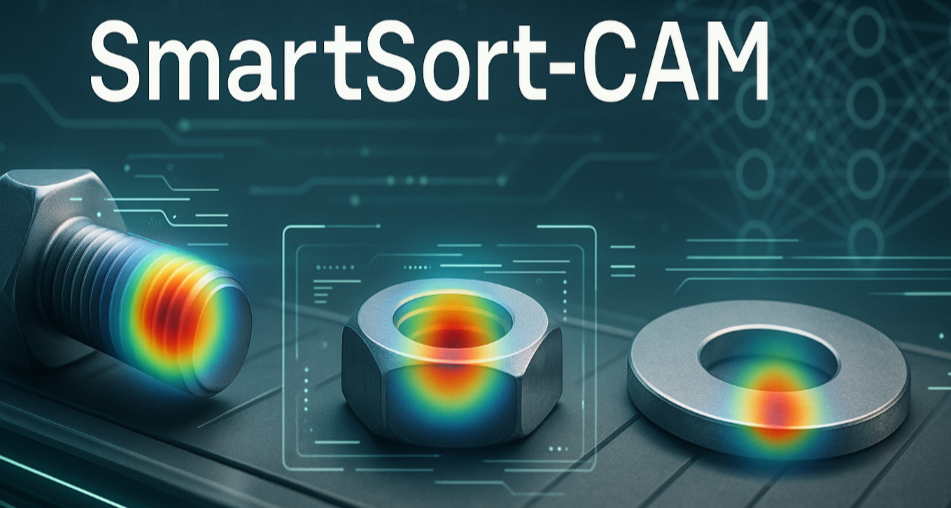
SmartSort-CAM is a comprehensive computer vision pipeline designed to classify industrial parts (bolts, nuts, washers, gears, bearings etc.) using a ConvNeXt-based deep learning model. The system includes a Blender-based synthetic dataset generator, a REST API for deployment, Grad-CAM visualization for explainability, Docker integration, and detailed exploratory analysis.
SmartSort-CAM/
├── app/                        # REST API handler
│   └── main.py                # Inference API client (calls FastAPI endpoint)
│
├── cv_pipeline/               # Core CV logic
│   └── inference.py           # Model loading, Grad-CAM, and FastAPI server
│
├── assets/                    # Blender rendering assets
│   ├── hdri/                  # HDR lighting maps
│   ├── textures/              # Steel surface textures
│   └── stl/                   # 3D models of industrial parts
│
├── data/                      # Synthetic dataset samples and label CSV
│   └── part_labels.csv
│   ├── test_images/
│   ├── dataset_samples/
│
├── outputs/                   # Inference results
│   ├── predictions/           # JSON output from API inference
│   └── visualizations/        # Grad-CAM image overlays
│
├── notebooks/                 # Exploratory and training notebooks
│   ├── exploratory.ipynb      # EDA of generated dataset
│   └── model_training.ipynb   # Training & evaluation of ConvNeXt
│
├── scripts/                   # Dataset rendering logic
│   └── Render_dataset.py      # Synthetic render generator using Blender
│
├── docker/                    # Containerization support
│   ├── Dockerfile
│   └── Makefile
│
├── requirements.txt           # Python dependencies
├── .gitignore
└── README.md
Located in scripts/Render_dataset.py, the rendering pipeline utilizes:
- Blender's Cycles Renderer for high-fidelity image generation.
- Randomized lighting (HDRI) via
setup_hdri_white_background(). - Random camera angles & object jitter using
setup_camera_aimed_at()andapply_positional_jitter(). - Steel texture application to STL meshes using
import_stl(). - HDRI strength and exposure control to simulate real-world lighting variance.
- Positional randomness and material reflectivity to increase dataset diversity.
The output directory is organized by class and tag (e.g., data/dataset_samples/bolt/good/bolt_001.png).
Finally, the script auto-generates a CSV:
filepath,label
bolt/good/bolt_001.png,bolt
...
This CSV is used for model training.
Found in notebooks/exploratory.ipynb, this notebook analyzes:
- Class distribution bar plots
- Image shape distributions
- Random render samples
- Augmentation previews
- Trained model sanity checks on generated images
This helped verify:
- Data cleanliness
- Label balance
- Visual consistency across categories
Defined in notebooks/model_training.ipynb:
- Backbone:
convnext_largefrom TIMM - Image Size: 512x512
- Loss: CrossEntropy
- Optim: AdamW
- Regularization: Dropout (0.3), weight decay (1e-5)
- Augmentations: Flip, rotation, color jitter
- Split: 80/20 train-validation split
- Validation Accuracy: 100% on synthetic validation set
- F1 / Precision / Recall: All 1.0 (confirmed clean split)
- Domain shift test (blur, noise, rotation): ~99.5% accuracy with high confidence
Found in cv_pipeline/inference.py, the pipeline offers:
- API Endpoint:
/predict - Input: Multipart image upload
- Outputs:
predicted_classconfidenceentropytop-3 predictionsgradcam_overlay(base64 PNG)
- Hooked into the last
conv_dwblock - Produces pixel-level heatmaps
- Visualizations show part regions influencing predictions
All inference outputs are saved to outputs/:
- Grad-CAM overlays:
outputs/visualizations/gradcam_bolt.png - API JSONs:
outputs/predictions/result_bolt.json
These can be used for audits, reports, or additional UI visualization.
In docker/, you’ll find:
FROM pytorch/pytorch:2.1.0-cuda11.8-cudnn8-runtime
WORKDIR /app
COPY . /app
RUN pip install --no-cache-dir -r requirements.txt
EXPOSE 8000
CMD ["uvicorn", "cv_pipeline.inference:app", "--host", "0.0.0.0", "--port", "8000"]make build # Builds Docker image
make run-gpu # Runs inference server with GPU
make stop # Stops all containers# Clone repo
https://github.com/gbr-rl/SmartSort-CAM
# Build Docker image
make build
# Run container (GPU)
make run-gpu
# Send test request
python app/main.py bolt.pngI’m excited to connect and collaborate!
- Email: gbrohiith@gmail.com
- LinkedIn: https://www.linkedin.com/in/rohiithgb/
- GitHub: https://github.com/GBR-RL/
This project is open-source and available under the MIT License.
🌟 If you like this project, please give it a star! 🌟