MemOS is an open-source Agent Memory framework that empowers AI agents with long-term memory, personality consistency, and contextual recall. It enables agents to remember past interactions, learn over time, and build evolving identities across sessions.
Designed for AI companions, role-playing NPCs, and multi-agent systems, MemOS provides a unified API for memory representation, retrieval, and update — making it the foundation for next-generation memory-augmented AI agents.
🆕 MemOS 2.0 introduces knowledge base system, multi-modal memory (images & documents), tool memory for Agent optimization, memory feedback mechanism for precise control, and enterprise-grade architecture with Redis Streams scheduler and advanced DB optimizations.













Get Free API: Try API
MemOS is an operating system for Large Language Models (LLMs) that enhances them with long-term memory capabilities. It allows LLMs to store, retrieve, and manage information, enabling more context-aware, consistent, and personalized interactions. MemOS 2.0 features comprehensive knowledge base management, multi-modal memory support, tool memory for Agent enhancement, and enterprise-grade architecture optimizations.
- Website: https://memos.openmem.net/
- Documentation: https://memos-docs.openmem.net/home/overview/
- API Reference: https://memos-docs.openmem.net/api-reference/configure-memos/
- Source Code: https://github.com/MemTensor/MemOS
Stay up to date with the latest MemOS announcements, releases, and community highlights.
- 2025-12-24 - 🎉 MemOS v2.0: Stardust (星尘) Release: Major upgrade featuring comprehensive Knowledge Base system with automatic document/URL parsing and cross-project sharing; Memory feedback mechanism for correction and precise deletion; Multi-modal memory supporting images and charts; Tool Memory to enhance Agent planning; Full architecture upgrade with Redis Streams multi-level queue scheduler and DB optimizations; New streaming/non-streaming Chat interfaces; Complete MCP upgrade; Lightweight deployment modes (quick & full).
- 2025-11-06 - 🎉 MemOS v1.1.3 (Async Memory & Preference): Millisecond-level async memory add (support plain-text-memory and preference memory); enhanced BM25, graph recall, and mixture search; full results & code for LoCoMo, LongMemEval, PersonaMem, and PrefEval released.
- 2025-10-30 - 🎉 MemOS v1.1.2 (API & MCP Update): API architecture overhaul and full MCP (Model Context Protocol) support — enabling models, IDEs, and agents to read/write external memory directly.
- 2025-09-10 - 🎉 MemOS v1.0.1 (Group Q&A Bot): Group Q&A bot based on MemOS Cube, updated KV-Cache performance comparison data across different GPU deployment schemes, optimized test benchmarks and statistics, added plaintext memory Reranker sorting, optimized plaintext memory hallucination issues, and Playground version updates. Try PlayGround
- 2025-08-07 - 🎉 MemOS v1.0.0 (MemCube Release): First MemCube with word game demo, LongMemEval evaluation, BochaAISearchRetriever integration, NebulaGraph support, enhanced search capabilities, and official Playground launch.
- 2025-07-29 – 🎉 MemOS v0.2.2 (Nebula Update): Internet search+Nebula DB integration, refactored memory scheduler, KV Cache stress tests, MemCube Cookbook release (CN/EN), and 4b/1.7b/0.6b memory ops models.
- 2025-07-21 – 🎉 MemOS v0.2.1 (Neo Release): Lightweight Neo version with plaintext+KV Cache functionality, Docker/multi-tenant support, MCP expansion, and new Cookbook/Mud game examples.
- 2025-07-11 – 🎉 MemOS v0.2.0 (Cross-Platform): Added doc search/bilingual UI, MemReader-4B (local deploy), full Win/Mac/Linux support, and playground end-to-end connection.
- 2025-07-07 – 🎉 MemOS 1.0 (Stellar) Preview Release: A SOTA Memory OS for LLMs is now open-sourced.
- 2025-07-04 – 🎉 MemOS Paper Released: MemOS: A Memory OS for AI System was published on arXiv.
- 2025-05-28 – 🎉 Short Paper Uploaded: MemOS: An Operating System for Memory-Augmented Generation (MAG) in Large Language Models was published on arXiv.
- 2024-07-04 – 🎉 Memory3 Model Released at WAIC 2024: The new memory-layered architecture model was unveiled at the 2024 World Artificial Intelligence Conference.
- 2024-07-01 – 🎉 Memory3 Paper Released: Memory3: Language Modeling with Explicit Memory introduces the new approach to structured memory in LLMs.
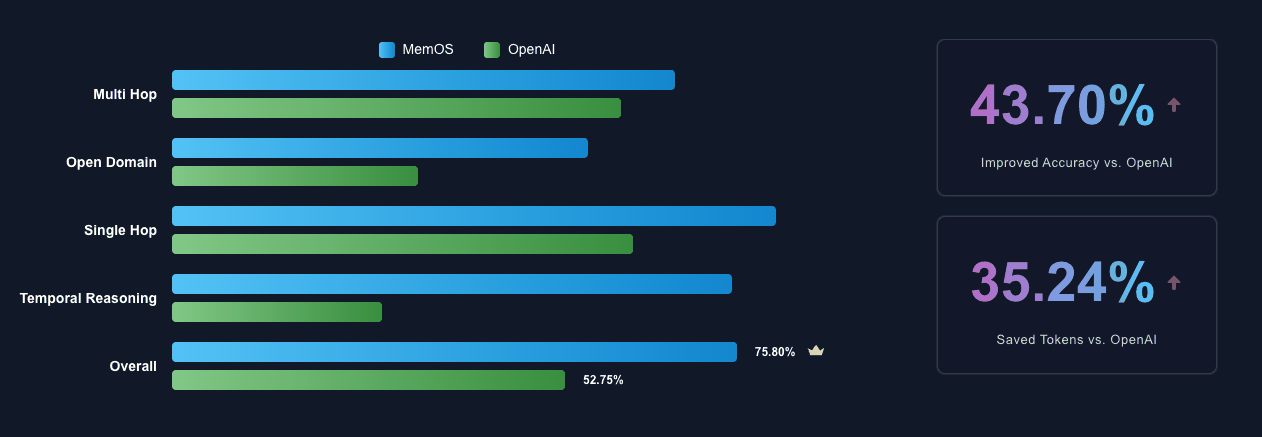
MemOS demonstrates significant improvements over baseline memory solutions in multiple memory tasks, showcasing its capabilities in information extraction, temporal and cross-session reasoning, and personalized preference responses.
| Model | LOCOMO | LongMemEval | PrefEval-10 | PersonaMem |
|---|---|---|---|---|
| GPT-4o-mini | 52.75 | 55.4 | 2.8 | 43.46 |
| MemOS | 75.80 | 77.80 | 71.90 | 61.17 |
| Improvement | +43.70% | +40.43% | +2568% | +40.75% |
- We use gpt-4o-mini as the processing and judging LLM and bge-m3 as embedding model in MemOS evaluation.
- The evaluation was conducted under conditions that align various settings as closely as possible. Reproduce the results with our scripts at
evaluation. - Check the full search and response details at huggingface https://huggingface.co/datasets/MemTensor/MemOS_eval_result.
💡 MemOS outperforms all other methods (Mem0, Zep, Memobase, SuperMemory et al.) across all benchmarks!
- 🧠 Memory-Augmented Generation (MAG): Provides a unified API for memory operations, integrating with LLMs to enhance chat and reasoning with contextual memory retrieval.
- 📦 Modular Memory Architecture (MemCube): A flexible and modular architecture that allows for easy integration and management of different memory types.
- 💾 Multiple Memory Types:
- Textual Memory: For storing and retrieving unstructured or structured text knowledge.
- Activation Memory: Caches key-value pairs (
KVCacheMemory) to accelerate LLM inference and context reuse. - Parametric Memory: Stores model adaptation parameters (e.g., LoRA weights).
- Tool Memory 🆕: Records Agent tool call trajectories and experiences to improve planning capabilities.
- 📚 Knowledge Base System 🆕: Build multi-dimensional knowledge bases with automatic document/URL parsing, splitting, and cross-project sharing capabilities.
- 🔧 Memory Controllability 🆕:
- Feedback Mechanism: Use
add_feedbackAPI to correct, supplement, or replace existing memories with natural language. - Precise Deletion: Delete specific memories by User ID or Memory ID via API or MCP tools.
- Feedback Mechanism: Use
- 👁️ Multi-Modal Support 🆕: Support for image understanding and memory, including chart parsing in documents.
- ⚡ Advanced Architecture:
- DB Optimization: Enhanced connection management and batch insertion for high-concurrency scenarios.
- Advanced Retrieval: Custom tag and info field filtering with complex logical operations.
- Redis Streams Scheduler: Multi-level queue architecture with intelligent orchestration for fair multi-tenant scheduling.
- Stream & Non-Stream Chat: Ready-to-use streaming and non-streaming chat interfaces.
- 🔌 Extensible: Easily extend and customize memory modules, data sources, and LLM integrations.
- 🏂 Lightweight Deployment 🆕: Support for quick mode and complete mode deployment options.
- Sign up and get started on
MemOS dashboard - Open the API Keys Console in the MemOS dashboard and copy the API Key into the initialization code
pip install MemoryOS -U- Initialize MemOS client with API Key to start sending requests
# Please make sure MemoS is installed (pip install MemoryOS -U)
from memos.api.client import MemOSClient

# Initialize the client using the API Key
client = MemOSClient(api_key="YOUR_API_KEY")- This API allows you to add one or more messages to a specific conversation. As illustrated in the examples bellow, you can add messages in real time during a user-assistant interaction, import historical messages in bulk, or enrich the conversation with user preferences and behavior data. All added messages are transformed into memories by MemOS, enabling their retrieval in future conversations to support chat history management, user behavior tracking, and personalized interactions.
messages = [
  {"role": "user", "content": "I have planned to travel to Guangzhou during the summer vacation. What chain hotels are available for accommodation?"},
  {"role": "assistant", "content": "You can consider [7 Days, All Seasons, Hilton], and so on."},
  {"role": "user", "content": "I'll choose 7 Days"},
  {"role": "assistant", "content": "Okay, ask me if you have any other questions."}
]
user_id = "memos_user_123"
conversation_id = "0610"
res = client.add_message(messages=messages, user_id=user_id, conversation_id=conversation_id)

print(f"result: {res}")- This API allows you to query a user’s memory and returns the fragments most relevant to the input. These can serve as references for the model when generating responses. As shown in the examples bellow, You can retrieve memory in real time during a user’s conversation with the AI, or perform a global search across their entire memory to create user profiles or support personalized recommendations, improving both dialogue coherence and personalization. In the latest update, in addition to “Fact Memory”, the system now supports “Preference Memory”, enabling LLM to respond in a way that better understands the user.
query = "I want to go out to play during National Day. Can you recommend a city I haven't been to and a hotel brand I haven't stayed at?"
user_id = "memos_user_123"
conversation_id = "0610"
res = client.search_memory(query=query, user_id=user_id, conversation_id=conversation_id)

print(f"result: {res}")- Get the repository.
git clone https://github.com/MemTensor/MemOS.git cd MemOS pip install -r ./docker/requirements.txt - Configure
docker/.env.exampleand copy toMemOS/.env
- The
OPENAI_API_KEY,MOS_EMBEDDER_API_KEY,MEMRADER_API_KEYand others can be applied for throughBaiLian. - Fill in the corresponding configuration in the
MemOS/.envfile.
- Start the service.
-
Launch via Docker
Tips: Please ensure that Docker Compose is installed successfully and that you have navigated to the docker directory (via
cd docker) before executing the following command.# Enter docker directory docker compose upIf you prefer to deploy using Docker, please refer to the
Docker Reference. -
Launch via the uvicorn command line interface (CLI)
uvicorn memos.api.server_api:app --host 0.0.0.0 --port 8001 --workers 1
For detailed integration steps, see the
CLI Reference.
Example
- Add User Message
import requests
import json

data = {
    "user_id": "8736b16e-1d20-4163-980b-a5063c3facdc",
    "mem_cube_id": "b32d0977-435d-4828-a86f-4f47f8b55bca",
    "messages": [
        {
            "role": "user",
            "content": "I like strawberry"
        }
    ],
    "async_mode": "sync"
}
headers = {
    "Content-Type": "application/json"
}
url = "http://localhost:8000/product/add"

res = requests.post(url=url, headers=headers, data=json.dumps(data))
print(f"result: {res.json()}")
- Search User Memory
import requests
import json

data = {
    "query": "What do I like",
    "user_id": "8736b16e-1d20-4163-980b-a5063c3facdc",
    "mem_cube_id": "b32d0977-435d-4828-a86f-4f47f8b55bca"
}
headers = {
    "Content-Type": "application/json"
}
url = "http://localhost:8000/product/search"

res = requests.post(url=url, headers=headers, data=json.dumps(data))
print(f"result: {res.json()}")
Join our community to ask questions, share your projects, and connect with other developers.
- GitHub Issues: Report bugs or request features in our GitHub Issues.
- GitHub Pull Requests: Contribute code improvements via Pull Requests.
- GitHub Discussions: Participate in our GitHub Discussions to ask questions or share ideas.
- Discord: Join our Discord Server.
- WeChat: Scan the QR code to join our WeChat group.
Note
We publicly released the Short Version on May 28, 2025, making it the earliest work to propose the concept of a Memory Operating System for LLMs.
If you use MemOS in your research, we would appreciate citations to our papers.
@article{li2025memos_long,
  title={MemOS: A Memory OS for AI System},
  author={Li, Zhiyu and Song, Shichao and Xi, Chenyang and Wang, Hanyu and Tang, Chen and Niu, Simin and Chen, Ding and Yang, Jiawei and Li, Chunyu and Yu, Qingchen and Zhao, Jihao and Wang, Yezhaohui and Liu, Peng and Lin, Zehao and Wang, Pengyuan and Huo, Jiahao and Chen, Tianyi and Chen, Kai and Li, Kehang and Tao, Zhen and Ren, Junpeng and Lai, Huayi and Wu, Hao and Tang, Bo and Wang, Zhenren and Fan, Zhaoxin and Zhang, Ningyu and Zhang, Linfeng and Yan, Junchi and Yang, Mingchuan and Xu, Tong and Xu, Wei and Chen, Huajun and Wang, Haofeng and Yang, Hongkang and Zhang, Wentao and Xu, Zhi-Qin John and Chen, Siheng and Xiong, Feiyu},
  journal={arXiv preprint arXiv:2507.03724},
  year={2025},
  url={https://arxiv.org/abs/2507.03724}
}

@article{li2025memos_short,
  title={MemOS: An Operating System for Memory-Augmented Generation (MAG) in Large Language Models},
  author={Li, Zhiyu and Song, Shichao and Wang, Hanyu and Niu, Simin and Chen, Ding and Yang, Jiawei and Xi, Chenyang and Lai, Huayi and Zhao, Jihao and Wang, Yezhaohui and others},
  journal={arXiv preprint arXiv:2505.22101},
  year={2025},
  url={https://arxiv.org/abs/2505.22101}
}

@article{yang2024memory3,
author = {Yang, Hongkang and Zehao, Lin and Wenjin, Wang and Wu, Hao and Zhiyu, Li and Tang, Bo and Wenqiang, Wei and Wang, Jinbo and Zeyun, Tang and Song, Shichao and Xi, Chenyang and Yu, Yu and Kai, Chen and Xiong, Feiyu and Tang, Linpeng and Weinan, E},
title = {Memory$^3$: Language Modeling with Explicit Memory},
journal = {Journal of Machine Learning},
year = {2024},
volume = {3},
number = {3},
pages = {300--346},
issn = {2790-2048},
doi = {https://doi.org/10.4208/jml.240708},
url = {https://global-sci.com/article/91443/memory3-language-modeling-with-explicit-memory}
}We welcome contributions from the community! Please read our contribution guidelines to get started.
MemOS is licensed under the Apache 2.0 License.


