



Evaluating AxonFlow in production? We're opening limited Design Partner slots.
Free 30-minute architecture and incident-readiness review, priority issue triage, roadmap input, and early feature access.
Apply here or email design-partners@getaxonflow.com.
No commitment required. We reply within 48 hours.
Questions or feedback?
Comment in GitHub Discussions or email hello@getaxonflow.com for private feedback.
Add invisible AI governance to your applications in 3 lines of code. No UI changes. No user training. Just drop-in enterprise protection.
This SDK is a client library for interacting with a running AxonFlow control plane. It is used from application or agent code to send execution context, policies, and requests at runtime.
A deployed AxonFlow platform (self-hosted or cloud) is required for end-to-end AI governance. SDKs alone are not sufficient—the platform and SDKs are designed to be used together.
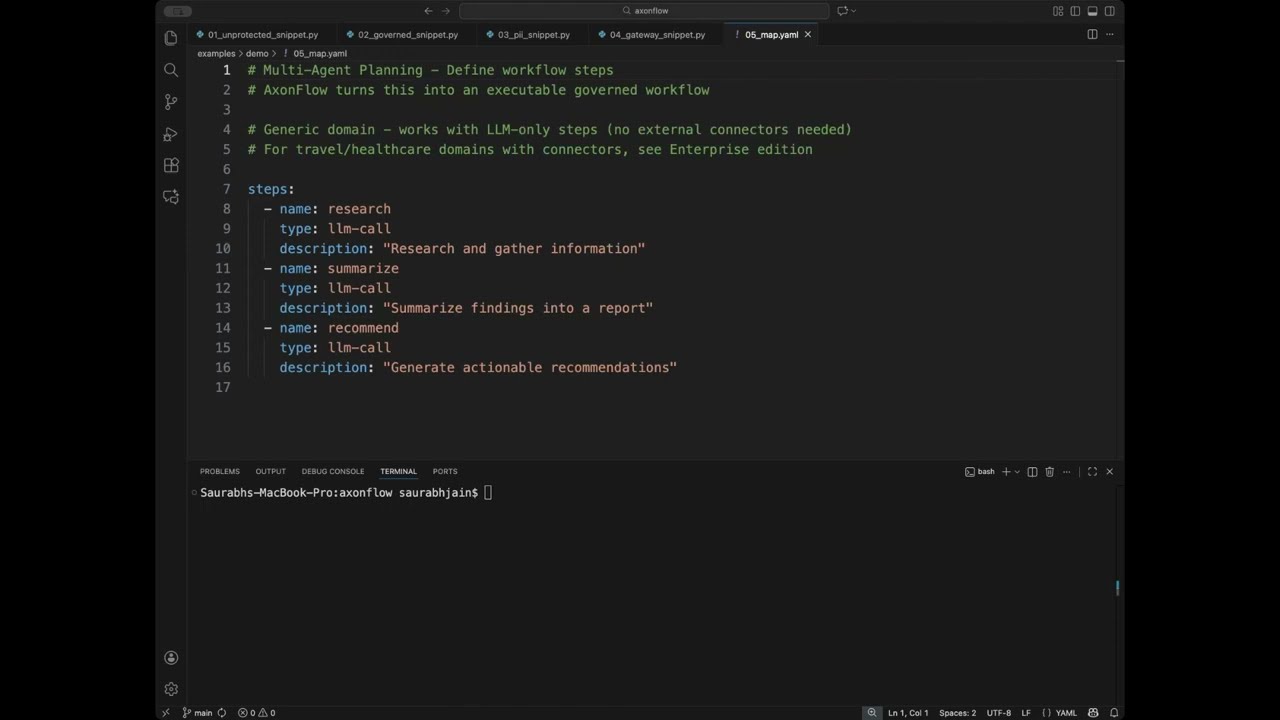
If you're new to AxonFlow, this short video shows how the control plane and SDKs work together in a real production setup:
npm install @axonflow/sdkgit clone https://github.com/getaxonflow/axonflow-sdk-typescript.git
cd axonflow-sdk-typescript && npm install && npm run build && npm link
# In your project: npm link @axonflow/sdkNeed more capacity than Community without moving to Enterprise? Evaluation uses the same core features with higher limits:
| Limit | Community | Evaluation (Free) | Enterprise |
|---|---|---|---|
| Tenant policies | 20 | 50 | Unlimited |
| Org-wide policies | 0 | 5 | Unlimited |
| Audit retention | 3 days | 14 days | 3650 days |
| Concurrent executions | 5 | 25 | Unlimited |
| Pending execution approvals | 5 | 25 | Unlimited |
Concurrent executions applies to MAP and WCP executions per tenant. Pending execution approvals applies to MAP confirm/step mode and WCP approval queues.
Get a free Evaluation license · Full feature matrix
Gateway Mode provides the most reliable integration by explicitly separating policy checks, LLM calls, and audit logging:
import { AxonFlow } from '@axonflow/sdk';
import OpenAI from 'openai';

// Initialize clients
const openai = new OpenAI({ apiKey: process.env.OPENAI_API_KEY });
const axonflow = new AxonFlow({
  clientId: process.env.AXONFLOW_CLIENT_ID,
  clientSecret: process.env.AXONFLOW_CLIENT_SECRET,
  endpoint: process.env.AXONFLOW_ENDPOINT || 'http://localhost:8080'
});

const prompt = 'What is the capital of France?';

// Step 1: Pre-check policies
const ctx = await axonflow.getPolicyApprovedContext({
  userToken: 'user-123',
  query: prompt
});

if (!ctx.approved) {
  throw new Error(`Blocked: ${ctx.blockReason}`);
}

// Step 2: Make your own LLM call
const startTime = Date.now();
const response = await openai.chat.completions.create({
  model: 'gpt-4',
  messages: [{ role: 'user', content: prompt }]
});
const latencyMs = Date.now() - startTime;

// Step 3: Audit the call
await axonflow.auditLLMCall({
  contextId: ctx.contextId,
  responseSummary: response.choices[0].message.content?.substring(0, 100) || '',
  provider: 'openai',
  model: 'gpt-4',
  tokenUsage: {
    promptTokens: response.usage?.prompt_tokens || 0,
    completionTokens: response.usage?.completion_tokens || 0,
    totalTokens: response.usage?.total_tokens || 0
  },
  latencyMs
});

console.log('Response:', response.choices[0].message.content);For simpler integrations, Proxy Mode handles policy checking and auditing in a single call:
import { AxonFlow } from '@axonflow/sdk';

const axonflow = new AxonFlow({
  clientId: process.env.AXONFLOW_CLIENT_ID,
  clientSecret: process.env.AXONFLOW_CLIENT_SECRET,
  endpoint: 'http://localhost:8080'
});

// Single call - policies checked, query processed, audit logged
const response = await axonflow.executeQuery({
  userToken: 'user-123',
  query: 'What is the capital of France?',
  requestType: 'chat',
  context: {
    provider: 'openai',
    model: 'gpt-4'
  }
});

if (response.success) {
  console.log('Response:', response.data);
}Connect to a self-hosted AxonFlow instance running via docker-compose:
import { AxonFlow } from '@axonflow/sdk';
import OpenAI from 'openai';

const openai = new OpenAI({ apiKey: process.env.OPENAI_API_KEY });

// Self-hosted (localhost) - no license key needed!
const axonflow = new AxonFlow({
  endpoint: 'http://localhost:8080'
  // That's it - no authentication required for localhost
});

// Use Gateway Mode for self-hosted
const prompt = 'Test with self-hosted AxonFlow';

const ctx = await axonflow.getPolicyApprovedContext({
  userToken: 'user-123',
  query: prompt
});

if (!ctx.approved) {
  throw new Error(`Blocked: ${ctx.blockReason}`);
}

const startTime = Date.now();
const response = await openai.chat.completions.create({
  model: 'gpt-4',
  messages: [{ role: 'user', content: prompt }]
});

// Don't forget to audit!
await axonflow.auditLLMCall({
  contextId: ctx.contextId,
  responseSummary: response.choices[0].message.content?.substring(0, 100) || '',
  provider: 'openai',
  model: 'gpt-4',
  tokenUsage: {
    promptTokens: response.usage?.prompt_tokens || 0,
    completionTokens: response.usage?.completion_tokens || 0,
    totalTokens: response.usage?.total_tokens || 0
  },
  latencyMs: Date.now() - startTime
});

console.log(response.choices[0].message.content);
Self-hosted deployment:
# Clone and start AxonFlow
git clone https://github.com/getaxonflow/axonflow.git
cd axonflow
export OPENAI_API_KEY=sk-your-key-here
docker-compose up

# SDK connects to http://localhost:8080 - no license needed!
Features:
- ✅ Full AxonFlow features without license
- ✅ Perfect for local development and testing
- ✅ Same API as production
- ✅ Automatically detects localhost and skips authentication
Proxy Mode routes all requests through AxonFlow's /api/request endpoint, providing a simpler integration pattern with automatic policy enforcement:
import { AxonFlow, PolicyViolationError } from '@axonflow/sdk';

const axonflow = new AxonFlow({
  clientId: process.env.AXONFLOW_CLIENT_ID,
  clientSecret: process.env.AXONFLOW_CLIENT_SECRET
});

// Execute a chat query with policy enforcement
const response = await axonflow.executeQuery({
  userToken: 'user-123',
  query: 'Explain quantum computing in simple terms',
  requestType: 'chat',
  context: {
    provider: 'openai',
    model: 'gpt-4'
  }
});

if (response.success) {
  console.log('Response:', response.data);
  console.log('Policies evaluated:', response.policyInfo?.policiesEvaluated);
}try {
await axonflow.executeQuery({
userToken: 'user-123',
query: 'Process this SSN: 123-45-6789',
requestType: 'chat'
});
} catch (error) {
if (error instanceof PolicyViolationError) {
console.log('Request blocked:', error.blockReason);
console.log('Violating policies:', error.policies);
}
}// SQL queries get additional injection detection
const sqlResponse = await axonflow.executeQuery({
userToken: 'analyst-user',
query: 'SELECT name, email FROM customers WHERE status = active LIMIT 100',
requestType: 'sql'
});// Check if AxonFlow agent is healthy
const health = await axonflow.healthCheck();
if (health.status === 'healthy') {
console.log('Agent version:', health.version);
console.log('Uptime:', health.uptime);
} else {
console.warn('Agent status:', health.status);
}| Request Type | Description |
|---|---|
chat |
General chat/LLM queries |
sql |
SQL queries (with injection detection) |
mcp-query |
MCP connector queries |
multi-agent-plan |
Generate multi-agent plans |
execute-plan |
Execute a generated plan |
Gateway Mode is for advanced users who want to make direct LLM calls while still getting policy enforcement:
// Step 1: Pre-check policies
const ctx = await axonflow.getPolicyApprovedContext({
  userToken: 'user-jwt',
  query: 'Analyze customer data',
  dataSources: ['postgres']
});

if (!ctx.approved) {
  throw new Error(`Blocked: ${ctx.blockReason}`);
}

// Step 2: Make direct LLM call with approved data
const llmResponse = await openai.chat.completions.create({
  model: 'gpt-4',
  messages: [{ role: 'user', content: JSON.stringify(ctx.approvedData) }]
});

// Step 3: Audit the call
await axonflow.auditLLMCall({
  contextId: ctx.contextId,
  responseSummary: llmResponse.choices[0].message.content.substring(0, 100),
  provider: 'openai',
  model: 'gpt-4',
  tokenUsage: {
    promptTokens: llmResponse.usage.prompt_tokens,
    completionTokens: llmResponse.usage.completion_tokens,
    totalTokens: llmResponse.usage.total_tokens
  },
  latencyMs: 250
});import { AxonFlow } from '@axonflow/sdk';
import { useState } from 'react';
const axonflow = new AxonFlow({
clientId: process.env.REACT_APP_AXONFLOW_CLIENT_ID,
clientSecret: process.env.REACT_APP_AXONFLOW_CLIENT_SECRET,
endpoint: process.env.REACT_APP_AXONFLOW_ENDPOINT || 'http://localhost:8080'
});
function ChatComponent() {
const [response, setResponse] = useState('');
const [error, setError] = useState<string | null>(null);
const handleSubmit = async (prompt: string) => {
setError(null);
try {
// Use Proxy Mode for simple integrations
// Note: In production, get userToken from your auth context
const result = await axonflow.executeQuery({
userToken: 'user-123', // Replace with actual user token
query: prompt,
requestType: 'chat'
});
if (result.success) {
setResponse(result.data);
}
} catch (err) {
setError(err instanceof Error ? err.message : 'An error occurred');
}
};
return (
// Your existing UI - no changes needed
<div>...</div>
);
}// pages/api/chat.ts
import { AxonFlow, PolicyViolationError } from '@axonflow/sdk';
import OpenAI from 'openai';
const openai = new OpenAI({ apiKey: process.env.OPENAI_API_KEY });
const axonflow = new AxonFlow({
clientId: process.env.AXONFLOW_CLIENT_ID,
clientSecret: process.env.AXONFLOW_CLIENT_SECRET,
endpoint: process.env.AXONFLOW_ENDPOINT || 'http://localhost:8080'
});
export default async function handler(req, res) {
const { prompt, userToken } = req.body;
try {
// Step 1: Pre-check policies
const ctx = await axonflow.getPolicyApprovedContext({
userToken: userToken || 'anonymous',
query: prompt
});
if (!ctx.approved) {
return res.status(403).json({ error: ctx.blockReason });
}
// Step 2: Make the LLM call
const startTime = Date.now();
const completion = await openai.chat.completions.create({
model: 'gpt-4',
messages: [{ role: 'user', content: prompt }]
});
const latencyMs = Date.now() - startTime;
// Step 3: Audit the call
await axonflow.auditLLMCall({
contextId: ctx.contextId,
responseSummary: completion.choices[0].message.content?.substring(0, 100) || '',
provider: 'openai',
model: 'gpt-4',
tokenUsage: {
promptTokens: completion.usage?.prompt_tokens || 0,
completionTokens: completion.usage?.completion_tokens || 0,
totalTokens: completion.usage?.total_tokens || 0
},
latencyMs
});
res.json({ success: true, response: completion.choices[0].message.content });
} catch (error) {
if (error instanceof PolicyViolationError) {
return res.status(403).json({ error: error.blockReason });
}
const message = error instanceof Error ? error.message : 'Unknown error';
res.status(500).json({ error: message });
}
}const axonflow = new AxonFlow({
// Authentication (OAuth2 client credentials)
clientId: 'your-client-id', // Required for cloud/enterprise
clientSecret: 'your-client-secret', // Required for cloud/enterprise
// Optional settings
mode: 'production', // or 'sandbox' for testing
endpoint: 'https://staging-eu.getaxonflow.com', // Default public endpoint
tenant: 'your-tenant-id', // For multi-tenant setups
debug: true, // Enable debug logging
// Retry configuration
retry: {
enabled: true,
maxAttempts: 3,
delay: 1000
},
// Cache configuration
cache: {
enabled: true,
ttl: 60000 // 1 minute
}
});For customers running within AWS VPC, use the private endpoint for lowest latency:
const axonflow = new AxonFlow({
  clientId: process.env.AXONFLOW_CLIENT_ID,
  clientSecret: process.env.AXONFLOW_CLIENT_SECRET,
  endpoint: 'https://vpc-private-endpoint.getaxonflow.com:8443',  // VPC private endpoint
  mode: 'production'
});

// VPC deployment provides lowest latency due to intra-VPC routing
Network Latency Characteristics:
- Public endpoint: Higher latency (internet routing overhead)
- VPC private endpoint: Lower latency (intra-VPC routing)
Note: VPC endpoints require AWS VPC peering setup with AxonFlow infrastructure.
// Use sandbox mode for testing without affecting production
const axonflow = AxonFlow.sandbox('demo-client', 'demo-secret');

// Test with PII detection (will be blocked)
try {
  const response = await axonflow.executeQuery({
    userToken: 'test-user',
    query: 'My SSN is 123-45-6789',
    requestType: 'chat'
  });
} catch (error) {
  // Expected: PolicyViolationError - PII detected
  console.log('Correctly blocked:', error.message);
}AxonFlow automatically:
- Blocks prompts containing sensitive data (PII, credentials, etc.)
- Redacts personal information from responses
- Enforces rate limits and usage quotas
- Prevents prompt injection attacks
- Logs all requests for compliance audit trails
- Monitors costs and usage patterns
import { AxonFlow, PolicyViolationError, AuthenticationError, APIError } from '@axonflow/sdk';

try {
  const response = await axonflow.executeQuery({
    userToken: 'user-123',
    query: prompt,
    requestType: 'chat'
  });
} catch (error) {
  if (error instanceof PolicyViolationError) {
    // Request violated a policy
    console.log('Policy violation:', error.blockReason);
    console.log('Policies:', error.policies);
  } else if (error instanceof AuthenticationError) {
    // Authentication failed
    console.error('Auth error:', error.message);
  } else if (error instanceof APIError) {
    // API error (status, statusText, body)
    console.error(`API error ${error.status}:`, error.body);
  } else {
    // Other errors
    console.error('Error:', error);
  }
}-
Environment Variables: Never hardcode credentials
const axonflow = new AxonFlow({
  clientId: process.env.AXONFLOW_CLIENT_ID,
  clientSecret: process.env.AXONFLOW_CLIENT_SECRET
});
-
Fail Open: In production, AxonFlow fails open if unreachable
// If AxonFlow is down, the original call proceeds
// This ensures your app stays operational
-
Tenant Isolation: Use tenant IDs for multi-tenant apps
const axonflow = new AxonFlow({
  clientId: process.env.AXONFLOW_CLIENT_ID,
  clientSecret: process.env.AXONFLOW_CLIENT_SECRET,
  tenant: getCurrentTenantId()
});
Complete working examples for all features are available in the examples folder.
// PII Detection - Automatically detect sensitive data
const result = await axonflow.getPolicyApprovedContext({
  userToken: 'user-123',
  query: 'My SSN is 123-45-6789'
});
// result.approved = true, result.requiresRedaction = true (SSN detected)

// SQL Injection Detection - Block prohibited queries
const result = await axonflow.getPolicyApprovedContext({
  userToken: 'user-123',
  query: "SELECT * FROM users WHERE role = 'admin'"
});
// result.approved = false, result.blockReason = "SQL query policy violation"

// Static Policies - List and manage built-in policies
const policies = await axonflow.listPolicies();
// Returns: [{name: "pii-detection", enabled: true}, ...]

// Dynamic Policies - Create runtime policies
await axonflow.createDynamicPolicy({
  name: 'block-competitor-queries',
  conditions: { contains: ['competitor', 'pricing'] },
  action: 'block'
});

// MCP Connectors - Query external data sources
const resp = await axonflow.queryConnector('postgres-db', 'SELECT name FROM customers', {});
// resp.data contains query results

// Multi-Agent Planning - Orchestrate complex workflows
const plan = await axonflow.generatePlan('Research AI regulations', 'legal');
const result = await axonflow.executePlan(plan.planId);

// Audit Logging - Track all LLM interactions
await axonflow.auditLLMCall({
  contextId: ctx.contextId,
  responseSummary: 'AI response summary',
  provider: 'openai',
  model: 'gpt-4',
  tokenUsage: { promptTokens: 100, completionTokens: 200, totalTokens: 300 },
  latencyMs: 450
});These features require an AxonFlow Enterprise license:
// Code Governance - Automated PR reviews with AI
const prResult = await axonflow.reviewPullRequest({
  repoOwner: 'your-org',
  repoName: 'your-repo',
  prNumber: 123,
  checkTypes: ['security', 'style', 'performance']
});

// Cost Controls - Budget management for LLM usage
const budget = await axonflow.getBudget('team-engineering');
// Returns: { limit: 1000.00, used: 234.56, remaining: 765.44 }

// MCP Policy Enforcement - Automatic PII redaction in connector responses
const resp = await axonflow.queryConnector('postgres', 'SELECT * FROM customers', {});
// resp.policyInfo.redacted = true
// resp.policyInfo.redactedFields = ['ssn', 'credit_card']
For enterprise features, contact sales@getaxonflow.com.
- Documentation: https://docs.getaxonflow.com
- Issues: https://github.com/getaxonflow/axonflow-sdk-typescript/issues
- Email: dev@getaxonflow.com
If you are evaluating AxonFlow in a company setting and cannot open a public issue, you can share feedback or blockers confidentially here: Anonymous evaluation feedback form
No email required. Optional contact if you want a response.
Integrate with external data sources using AxonFlow's MCP (Model Context Protocol) connectors:
const connectors = await axonflow.listConnectors();

connectors.forEach(conn => {
  console.log(`Connector: ${conn.name} (${conn.type})`);
  console.log(`  Description: ${conn.description}`);
  console.log(`  Installed: ${conn.installed}`);
  console.log(`  Capabilities: ${conn.capabilities.join(', ')}`);
});await axonflow.installConnector({
connector_id: 'amadeus-travel',
name: 'amadeus-prod',
tenant_id: 'your-tenant-id',
options: {
environment: 'production'
},
credentials: {
api_key: process.env.AMADEUS_API_KEY,
api_secret: process.env.AMADEUS_API_SECRET
}
});
console.log('Connector installed successfully!');// Query the Amadeus connector for flight information
const resp = await axonflow.queryConnector(
'amadeus-prod',
'Find flights from Paris to Amsterdam on Dec 15',
{
origin: 'CDG',
destination: 'AMS',
date: '2025-12-15'
}
);
if (resp.success) {
console.log('Flight data:', resp.data);
} else {
console.error('Query failed:', resp.error);
}AxonFlow now supports 7 production-ready connectors:
Query Salesforce data using SOQL:
// Query Salesforce contacts
const contacts = await axonflow.queryConnector(
  'salesforce-crm',
  'Find all contacts for account Acme Corp',
  {
    soql: "SELECT Id, Name, Email, Phone FROM Contact WHERE AccountId = '001xx000003DHP0'"
  }
);

console.log(`Found ${contacts.data.length} contacts`);
Authentication: OAuth 2.0 password grant (configured in AxonFlow dashboard)
Execute analytics queries on Snowflake:
// Query Snowflake for sales analytics
const analytics = await axonflow.queryConnector(
  'snowflake-warehouse',
  'Get monthly revenue for last 12 months',
  {
    sql: `SELECT DATE_TRUNC('month', order_date) as month,
          COUNT(*) as orders,
          SUM(amount) as revenue
          FROM orders
          WHERE order_date >= DATEADD(month, -12, CURRENT_DATE())
          GROUP BY month
          ORDER BY month`
  }
);

console.log('Revenue data:', analytics.data);
Authentication: Key-pair JWT authentication (configured in AxonFlow dashboard)
Send notifications and alerts to Slack channels:
// Send Slack notification
const result = await axonflow.queryConnector(
  'slack-workspace',
  'Send deployment notification to #engineering channel',
  {
    channel: '#engineering',
    text: '🚀 Deployment complete! All systems operational.',
    blocks: [
      {
        type: 'section',
        text: {
          type: 'mrkdwn',
          text: '*Deployment Status*\n✅ All systems operational'
        }
      }
    ]
  }
);

console.log('Message sent:', result.success);
Authentication: OAuth 2.0 bot token (configured in AxonFlow dashboard)
| Connector | Type | Use Case |
|---|---|---|
| PostgreSQL | Database | Relational data access |
| Redis | Cache | Distributed rate limiting |
| Slack | Communication | Team notifications |
| Salesforce | CRM | Customer data, SOQL queries |
| Snowflake | Data Warehouse | Analytics, reporting |
| Amadeus GDS | Travel | Flight/hotel booking |
| Cassandra | NoSQL | Distributed database |
For complete connector documentation, see https://docs.getaxonflow.com/mcp
Prevent large-scale data extraction with automatic row and byte limits:
// Query with exfiltration limits (default: 10K rows, 10MB)
const response = await axonflow.queryConnector('postgres', 'SELECT * FROM customers', {});

// Check exfiltration info
if (response.policyInfo?.exfiltrationCheck?.exceeded) {
  console.log('Data limit exceeded:', response.policyInfo.exfiltrationCheck.limitType);
  // limitType: 'rows' | 'bytes'
}

// Configure limits via environment:
// MCP_MAX_ROWS_PER_QUERY=1000
// MCP_MAX_BYTES_PER_QUERY=5242880Enable Orchestrator-based policy evaluation for rate limiting, budget controls, and more:
// Response includes dynamic policy info when enabled
const response = await axonflow.queryConnector('postgres', 'SELECT id FROM users', {});

// Check dynamic policy evaluation results
const dynamicInfo = response.policyInfo?.dynamicPolicyInfo;
if (dynamicInfo?.orchestratorReachable) {
  console.log('Policies evaluated:', dynamicInfo.policiesEvaluated);
  dynamicInfo.matchedPolicies?.forEach(policy => {
    console.log(`  ${policy.policyName}: ${policy.action}`);
  });
}

// Enable via environment:
// MCP_DYNAMIC_POLICIES_ENABLED=trueGenerate and execute complex multi-step plans using AI agent orchestration:
// Generate a travel planning workflow
const plan = await axonflow.generatePlan(
  'Plan a 3-day trip to Paris with moderate budget',
  'travel'  // Domain hint (optional)
);

console.log(`Generated plan ${plan.planId} with ${plan.steps.length} steps`);
console.log(`Complexity: ${plan.complexity}, Parallel: ${plan.parallel}`);

plan.steps.forEach((step, i) => {
  console.log(`  Step ${i + 1}: ${step.name} (${step.type})`);
  console.log(`    Description: ${step.description}`);
  console.log(`    Agent: ${step.agent}`);
  if (step.dependsOn.length > 0) {
    console.log(`    Depends on: ${step.dependsOn.join(', ')}`);
  }
});// Execute the generated plan
const execResp = await axonflow.executePlan(plan.planId);
console.log(`Plan Status: ${execResp.status}`);
console.log(`Duration: ${execResp.duration}`);
if (execResp.status === 'completed') {
console.log(`Result:\n${execResp.result}`);
// Access individual step results
Object.entries(execResp.stepResults || {}).forEach(([stepId, result]) => {
console.log(` ${stepId}:`, result);
});
} else if (execResp.status === 'failed') {
console.error(`Error: ${execResp.error}`);
}// For long-running plans, check status periodically
const status = await axonflow.getPlanStatus(plan.planId);
console.log(`Plan Status: ${status.status}`);
if (status.status === 'running') {
console.log('Plan is still executing...');
}import { AxonFlow } from '@axonflow/sdk';
async function planTrip() {
// Initialize client with OAuth2 credentials
const axonflow = new AxonFlow({
clientId: process.env.AXONFLOW_CLIENT_ID,
clientSecret: process.env.AXONFLOW_CLIENT_SECRET,
debug: true
});
// 1. Generate multi-agent plan
const plan = await axonflow.generatePlan(
'Plan a 3-day trip to Paris for 2 people with moderate budget',
'travel'
);
console.log(`✅ Generated plan with ${plan.steps.length} steps (parallel: ${plan.parallel})`);
// 2. Execute the plan
console.log('\n🚀 Executing plan...');
const execResp = await axonflow.executePlan(plan.planId);
// 3. Display results
if (execResp.status === 'completed') {
console.log(`\n✅ Plan completed in ${execResp.duration}`);
console.log(`\n📋 Complete Itinerary:\n${execResp.result}`);
} else {
console.error(`\n❌ Plan failed: ${execResp.error}`);
}
}
planTrip().catch(console.error);If you're using older authentication methods (apiKey or licenseKey), migrate to OAuth2 client credentials:
Before (v2.x):
const axonflow = new AxonFlow({
  apiKey: process.env.AXONFLOW_API_KEY
});
// or
const axonflow = new AxonFlow({
  licenseKey: process.env.AXONFLOW_LICENSE_KEY
});
After (v3.x):
const axonflow = new AxonFlow({
  clientId: process.env.AXONFLOW_CLIENT_ID,
  clientSecret: process.env.AXONFLOW_CLIENT_SECRET
});
How to get credentials:
- Contact AxonFlow support at dev@getaxonflow.com
- Credentials are provided as part of your AxonFlow subscription
- Store credentials securely in environment variables or secrets management systems
Self-hosted users: No credentials required for localhost endpoints.
MIT
