control
-
Twenty years of attempting to control the Vespa velutina invasion: will we win the battle?
D Thiery, K Monceau - Entomologia Generalis - 2024
- Twenty years later, the whole French territory is invaded as well as neighboring European countries.
- The lack of a global European strategy both from stakeholders but also among scientists probably contributed to the success of the invasion.
- With 20 years’ hindsight on this invasion, we can take stock of the illusions and disillusions in the fight against this highly effective invader.
-
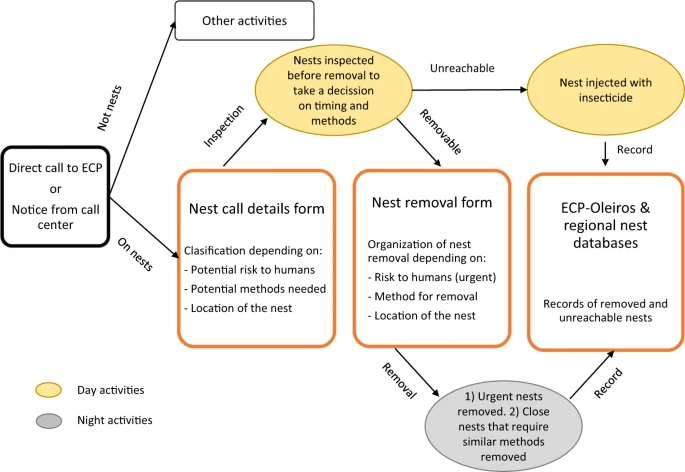
T Pazos, P Álvarez-Figueiró - Environmental Management - 2022
-
L Turchi, B Derijard - Journal of Applied Entomology - 2018
-
SV Rojas-Nossa, S Mato, P Feijoo, A Lagoa, J Garrido - Animals - 2023
- (a) VespaCatch (V trap), (b) Econex (X trap), (c) Eva (E trap), and (d) a trap in development (R trap)
- The Eva (E) trap had a higher effectiveness and a higher selectiveness. The prototype (R trap) had the lowest effectiveness and selectiveness. The VespaCatch (V) and Econex (X) traps had higher capture rates, but also the lowest selectiveness, with captures of vulnerable native species.
- The results indicate that, with the tested traps, bait trapping continues to be environmentally unsustainable and not recommended as a control method in regions with an established invasive population.

-
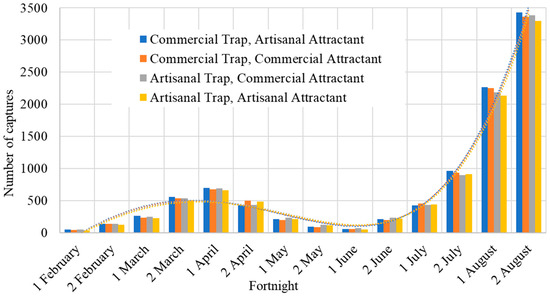
F Mata, JM Alonso, C Cano-Díaz - Applied Sciences - 2024
- Commercial attractant: VespaCatch produced by Véto-Pharma and sold in 10 mL sachets.
- Artisanal attractant is produced using a mix of water, sugar (100 g per litre of water), and bakery yeast (a coffee spoon per litre of water).

-
O Sánchez, A Arias - Biology - 2021
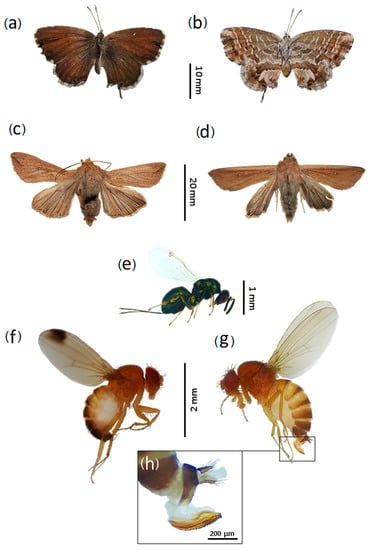
- Exotic and invasive species captured in the studied V. velutina traps. Cacyreus marshalli (Lepidoptera: Lycaenidae) dorsal view (a); ventral view of the same (b); Male of Mythimna unipuncta (Lepidoptera: Noctuidae) (c); female of the same (d); female of Torymus sinensis (Hymenoptera: Torymidae) (e); male of Drosophila suzukii (Diptera: Drosophilidae) (f); female of the same (g); detail of the oviscapt of female D. suzukii (h).


-
SV Rojas-Nossa, N Novoa, A Serrano - Apidologie - 2018
- During spring in 2016, three types of trap and baits in a full factorial design were tested. Vespa velutina accounted for less than 1% of all captures, reflecting the low selectiveness of the method.
- All trap-bait combinations captured a very high quantity of dipterans, native hymenopterans, and lepidopterans. High capture rates of insect groups which are not common prey of V. velutina reflect that the method constitutes an additional threat on native insects.
-
Effectiveness and Selectiveness of Traps and Baits for Catching the Invasive Hornet Vespa velutina
S Lioy, D Laurino, M Capello, A Romano, A Manino - Insects - 2020
- In spring, traps with common beer as bait were more effective and more selective independently of trap’s model than the commercial bait that has been tested. On the contrary, in autumn, just one combination of trap and attractant (the commercial trap and bait) achieved higher effectiveness and selectiveness.
- Despite the underlined variations among traps and baits, overall catches of V. velutina were scanty compared to bycatches of non-target insects, since best performing traps either in term of effectiveness and selectiveness caught 3.65% of the target species in spring and 1.35% in autumn upon the total trapped insects.
- This highlights the urgent necessity of developing more selective trapping methods for monitoring and particularly for controlling purposes.

-
Does spring trapping yellow-legged Asian hornets work?
R Brouard, C Guespin, ML Legroux
- Spring trapping reduced secondary nest density by 64% compared to 2022.
- The campaign increased public awareness and reporting of primary nests by 67% in 2023.
- Bycatch remained low at under 300g per year, minimizing impact on beneficial insects.
- The initiative led to no reported hornet incidents in the municipality over the past two years.
-
Trapping is not effective for limiting damage by Vespa velutina in vineyards
Yaiza R. Lueje, Amalia Jácome, Jaime Fagúndez
- The multifactorial nature of V. velutina damage in vineyards, and the high proportion and diversity of by-catch in traps make trap use unadvisable based on the present state of knowledge.
- More sustainable and effective methods of vineyard management and crop protection should be tested to guarantee the future of this productive sector in highly invaded areas.
-
Olfactory Attraction of the Hornet Vespa velutina to Honeybee Colony Odors and Pheromones
A Couto, K Monceau, O Bonnard, D Thiéry - PLoS One - 2014
-
- In a multiple choice test performed under controlled laboratory conditions, we found that hornets are strongly attracted to the odor of some hive products, especially pollen and honey. - When testing specific compounds, the honeybee aggregation pheromone, geraniol, proved highly attractive. - Pheromones produced by honeybee larvae or by the queen were also of interest to hornet workers, albeit to a lesser extent.
-
MS Rodríguez-Flores, A Diéguez-Antón - Journal of Plant Research - 2025
-
SV Rojas‐Nossa, D Dasilva‐Martins - Pest Management Science - 2022
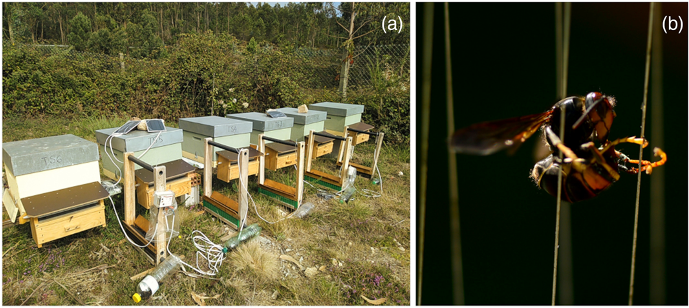
- Electric harps contribute significantly to mitigate the impact of this invasive hornet on apiaries
- They should be deployed in tandem with additional measures to preserve honey bee colony stocks, such as facilitating access to food sources for colonies during the periods of highest predation pressure.
-
D Thiéry, M Doblas-Bajo, Z Tourrain - Entomologia, 2023
- Owing to their low impact on biodiversity, such interception non baited traps provide a good protection of hives as tested in small apiaries, and we advise beekeepers to use these traps for hives situated in areas with high predation pressure.
-
JF Barandika, O de la Hera, R Fañanás, A Rivas - Animals - 2023
- A protein bait with a 0.01% concentration of fipronil was effective in inactivating and killing the larvae
- This can reduce the pressure of the hornets on the hives for at least two weeks after baiting.
- Bees can recover their normal activity.

-
P Malaquias Souto, A Sarmento, N Capela, A Aguilar - PloS one - 2025
- Our results suggest acetamiprid and spinosad as promising candidates for the yellow-legged hornet control.
- Further research is needed to validate their efficacy under field conditions and assess ecological impacts of these pesticides on non-target organisms.
-
I Ruiz-Cristi, L Berville, E Darrouzet - PloS one, 2020 - journals.plos.org
- The European Union has classified V. velutina as a species of concern because the hornet significantly affects beekeeping activities, mostly by preying honeybees (Apis mellifera) at beehive entrances.
- No current control method is simultaneously eco-friendly and effective.
- Here, we aimed to develop a greener technique for destroying V. velutina nests, inspired by a defense behavior used by the eastern honeybee (Apis cerana), the “heat ball”.
- Hornets died faster when the temperature was gradually increased than when it was instantaneously increased; larvae seemed to be more thermally tolerant. The most promising and potential technique for quickly destroying hornet nests may be steam injection, as the humid airflow system killed all hornets within 13 seconds, and therefore could be a good candidate for a green nest control method.
-
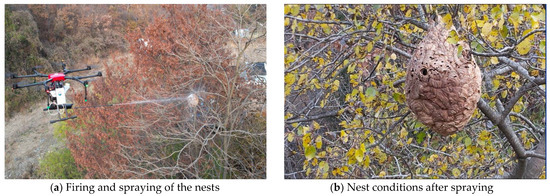
Exterminator for the Nests of Vespa velutina nigrithorax Using an Unmanned Aerial Vehicle
CG Lee, SH Yu - Drones - 2023
- Pesticides and bullets were manufactured using ecofriendly materials.
- An insecticidal effect of over 99% was achieved using two pyrethrum-based pesticides (15% pyrethrum extract and 10% pyrethrum extract with additives).
-
JA Martín Ávila, S Rebollo - Pest Management - 2025
-
JÁ Martín‐Ávila, LM Díaz‐Aranda - Pest Management - 2025
-
N Onofre, MI Portugal e Castro, A Nave, Animals - 2023
- The Yellow-legged Hornet, an invasive species that entered Europe through France in 2004, poses a significant threat to biodiversity and beekeeping.
- Control measures have failed to halt its spread, highlighting the need for all possible methods of management, including natural predators.
- The diet of the European Bee-eater was studied to assess its predation on the Yellow-legged Hornet, with hornet remains found in Central Portugal.
- While the predation's significance is still unclear, the Bee-eater may contribute to biological control, especially as their ranges are likely to overlap more in other parts of Europe.
-
C Bartolomé, D Dasilva-Martíns, R Valiñas - Journal of Invertebrate - 2024
- Prevalences depended on the parasite family, the location, the season and the host.
- V. velutina displayed significantly less parasite occurrence than local Hymenoptera.
- V. velutina did not introduce new parasites into the invaded territories.

-
M Lacombrade, N Rocher, B Mahot-Castaing - bioRxiv - 2024
- Hornets had consistently lower survival, even under low concentrations of spores, when compared to wasps and bumblebees. Such lower susceptibility of beneficial Hymenoptera is encouraging in the perspectives of using M. robertsii as biocontrol agent against invasive hornets.
-
LB Gabín-García, C Bartolomé, C Guerra-Tort - Scientific reports - 2021
- Findings indicate that V. velutina harbors a variety of common hymenopteran enteropathogens, including several new parasitic taxa.
- The parasite diversity in V. velutina is most similar to that of V. crabro, suggesting potential interactions between these species.
- Despite high population densities (around of 100,000 individuals per km2 per year) of V. velutina in Europe, no clear evidence of pathogen release was found, raising concerns about its potential to disrupt native pathogen-host dynamics and harm local entomofauna.
-
Mazzei, G Cilia, M Forzan, A Lavazza, F Mutinelli - Scientific Reports - 2019
- In conclusion, the results of this investigation indicate that the honey bee pathogens KBV and BQCV could successfully infect V. velutina, although in an asymptomatic form.